From Bricks to Second Brains: The Wild, Nostalgic Journey of the Mobile Phone Revolution
Introduction: The Sound of Inevitability
If you close your eyes and think back 20 years, you can probably hear it. The specific, crunchy beep-beep-beep of tapping out a text message on a rubber keypad. The tinny MIDI version of a pop song serving as a ringtone. The anxiety of having only 10% battery left, knowing that meant your phone would die in about... three days.
We are currently living through one of the fastest technological accelerations in human history. The device you are likely reading this on right now—a sleek slab of glass and silicon—has more computing power than the entirety of NASA back when they sent astronauts to the moon.
But it didn't start this way. The journey of the mobile phone from "simple" to "smart" is a fascinating tale of innovation, design wars, and a complete rewiring of how human beings communicate.
Let’s take a walk down memory lane, starting when phones required shoulder straps.
Phase 1: The Dawn of the "Brick" (1980s - Early 90s)
In 1973, Martin Cooper of Motorola made the first publicized handheld mobile phone call to his rival at Bell Labs. But it wasn't until the 1980s that the technology became commercially available, and even then, only to the ultra-wealthy or high-powered Gordon Gekko types.
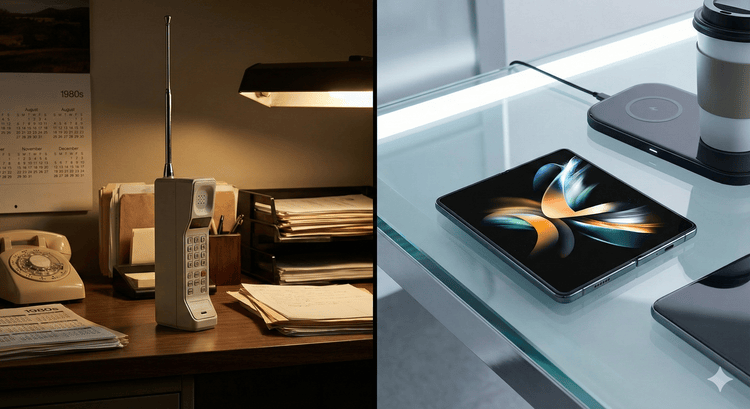
These devices, like the iconic Motorola DynaTAC 8000x, weren't really "mobile" in the modern sense. They were luggable.
They weighed over two pounds (about the same as a bag of sugar). They cost nearly $4,000 (around $10,000 today adjusted for inflation). You had to charge them for ten hours just to get 30 minutes of talk time. And they did exactly one thing: make phone calls. There was no texting, no contact lists, and certainly no internet.
Yet, they were revolutionary. For the first time, you weren't untethered to a wall. You were reachable.

Phase 2: The Golden Age of the Feature Phone & The Reign of Nokia (Mid 90s - Mid 2000s)
If the 80s were about making the phone mobile, the late 90s and early 2000s were about making it personal. This was the era that truly democratized mobile technology.
Phones shrunk dramatically. Antennas disappeared inside the casing. Prices dropped. And suddenly, everyone—from teenagers to grandparents—had one.
This era belonged to one undisputed king: Nokia.
The Nokia 3310 wasn't just a phone; it was a cultural icon. It was famously indestructible (legend says they are still functioning today at the bottom of the ocean). It introduced changeable faceplates, allowing for the first real mobile personalization.
More importantly, this era introduced features that changed our behavior:
SMS (Short Message Service): We learned a new language. "See you later" became "C U L8R" because we were limited to 160 characters and had to wrestle with T9 predictive text.
Ringtones: The "Crazy Frog" era. People actually paid money to have their phone play monotone, and later polyphonic, versions of hit songs.
Gaming: It started simple. It started with a pixelated snake eating dots and getting longer. Countless hours of human productivity were lost to Snake.
At this point, the phone was still primarily a communication tool, but it was beginning to creep into entertainment.

Phase 3: The Pivot Point—2007 and the iPhone Moment
It is rare that we can pinpoint a specific day when the world changed, but January 9, 2007, is one of them.
Steve Jobs walked onto a stage at Macworld and announced three products: a widescreen iPod with touch controls, a revolutionary mobile phone, and a breakthrough internet communicator. The twist, of course, was that these were not three separate devices. They were one. The iPhone.
Before the iPhone, "smartphones" existed, but they were clunky devices meant for business people, usually featuring dozens of tiny physical plastic buttons (looking at you, BlackBerry).
Apple killed the physical keyboard. They introduced "Multi-Touch"—the pinch-to-zoom and swipe gestures that even toddlers intuitively understand today. They realized that the phone screen shouldn't be a static display; it should be a blank canvas that changes based on what application you are using.
Suddenly, the internet wasn't something you "went on" at a desk. It was something you carried in your pocket.

Phase 4: The App Explosion and the Android Wars (2010 - 2018)
Once the iPhone kicked down the door, the floodgates opened. Google responded with Android, creating an open ecosystem that allowed manufacturers like Samsung, HTC, and LG to iterate wildly.
The hardware got better fast. Cameras went from grainy VGA afterthoughts to rivals for DSLRs. Screens got bigger, brighter, and sharper (Retina displays). 3G networks gave way to 4G LTE, making mobile video streaming a reality.
But the real revolution wasn't hardware; it was Software.
The introduction of the App Store (and Google Play) turned the phone from a static tool into an infinitely expandable Swiss Army Knife.
We stopped buying physical maps (Google Maps).
We stopped buying digital cameras (Instagram).
We stopped hailing taxis with our hands (Uber).
We stopped carrying cash (Apple Pay/Google Wallet).
The phone became the central hub of our digital existence, for better or worse. It also marked the beginning of the "always-on" culture, where the boundary between work, life, and social media blurred into an endless feed.
Phase 5: The Modern Era—AI, Foldables, and the "Second Brain" (Present Day)
Where are we now? We have reached a point of peak smartphone maturity. The black glass rectangle has been perfected.
To find innovation now, companies are looking to change the form factor again—witness the rise of foldable phones that bend glass screens in half, offering tablet-sized experiences that fit in a pocket.
But the biggest frontier is invisible: Artificial Intelligence.
Modern smartphones are leveraging AI not just for voice assistants like Siri or Google Assistant, but for everything.
Photography: Your phone is doing billions of calculations every time you snap a picture to correct lighting, smooth skin, and blur backgrounds. It’s "computational photography."
Predictive behavior: Your phone knows where you are likely going next Tuesday at 3 PM before you do.
On-device processing: Powerful new chips (NPUs) allow phones to run complex AI models locally, without needing the cloud, enhancing privacy and speed.
The journey from simple to smart is complete. The mobile phone is no longer just a phone; it is an external hard drive for our memories and a second brain for processing our daily lives.

Conclusion: The Next 40 Years
Looking back at the 1980s brick phone, it seems almost comical. Yet, that device started a chain reaction that connected billions of people.
It took about 40 years to get from a 2-pound analog brick to a 5G, AI-powered foldable supercomputer. What will the next 40 years bring? Will the phone disappear entirely, replaced by augmented reality glasses or neural implants like Neuralink?
Whatever happens, the journey of the mobile phone remains one of the most defining stories of modern humanity. And to think, it all started just because we wanted to make a call without standing next to a wall.




No comments yet. Be the first to share your thoughts!