The Great AI Standoff: ChatGPT vs. Gemini vs. Claude vs. The World. Who Actually Wins?
We are living through a historical inflection point. It’s the kind of moment where, twenty years from now, you’ll remember where you were when you realized everything had changed.
The graphical user interface changed how we saw computers. The iPhone changed how we connected. The arrival of generative AI is changing how we think.
For the past two years, we have witnessed an absolute deluge of innovation. It’s an arms race of staggering proportions, with tech giants throwing billions of dollars into compute power to build the "ultimate" synthetic brain. But for the average user, this speed is paralyzing. Every week there is a new model, a new benchmark, a new claim to the throne.
You don't need another dry list of features. You need to know the narrative. You need to understand the personality of these digital titans so you can choose the right ally for the cognitive revolution.
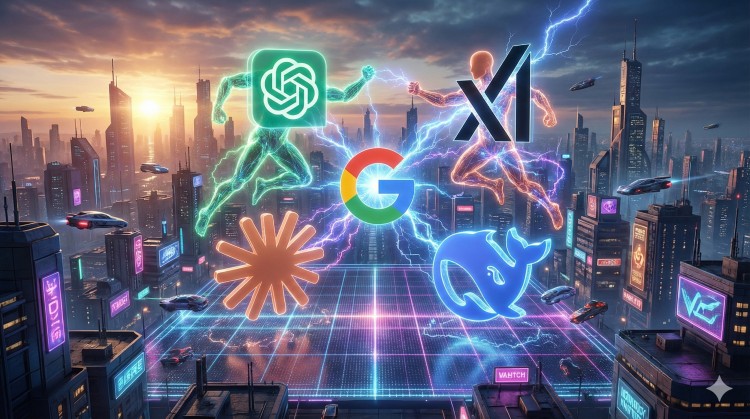
Today, we are stepping into the arena to pit the heavyweights against each other: the pioneer (ChatGPT), the ecosystem giant (Gemini), the ethical intellectual (Claude), the wildcard (Grok), and the dark horse (DeepSeek).
Buckle up. The future is getting weird.
The Landscape: It's Not Just About Smarts Anymore

Before we analyze the fighters, we must understand the battleground.
A year ago, the measure of an AI was simply "how well can it write an email?" Today, that bar is laughably low. The new battleground is multimodality and context.
Multimodality: The ability of the AI to not just read text, but to "see" images, "hear" audio, write code, and generate visuals simultaneously. The best AI is no longer just a chatbot; it's an omniscient analyst.
Context Window: This is the AI's working memory. How much information can you feed it before it starts forgetting the beginning of the conversation? This has gone from a few pages of text to literal books worth of information in a single prompt.
The winner of this race isn't just the smartest; it's the most versatile, the most integrated, and the most reliable.
1. The Reigning Champion: ChatGPT (OpenAI)
If AI is a religion, ChatGPT is its original prophet.
OpenAI didn't just launch a product in late 2022; they shattered the Overton window of what the public believed computers could do. Because of this first-mover advantage, "ChatGPT" has become the generic trademark for AI, like "Kleenex" or "Google."
The Vibe: The Reliable Swiss Army Knife
ChatGPT, particularly with its latest GPT-4o (omni) model, feels like the most mature product. It is incredibly versatile. It’s good at almost everything, rarely terrible at anything, and has the most robust ecosystem of custom "GPTs" and plugins.
The Superpowers:
GPT-4o Speed and Multimodality: The 'o' stands for omni. Its ability to handle audio, vision, and text in near real-time is uncanny. The voice mode feels less like talking to Siri and more like talking to the computer from Star Trek.
Reasoning Capabilities: When you need complex logical deduction or to break down a massive problem step-by-step, GPT-4 often still holds the edge in raw reasoning power.
Integration: It is everywhere. It’s in Microsoft’s Copilot, it’s integrated into countless apps, and its API is the standard.
The Weakness:
It can feel sterilized. In OpenAI's quest for safety, ChatGPT can sometimes feel overly corporate, preachy, or hesitant to engage with edgy topics compared to its rivals.
Best For: Everyday tasks, complex reasoning, and users who want the "default" AI experience with the widest range of features.
2. The Ecosystem Empire: Gemini (Google)
Google was caught sleeping at the wheel when ChatGPT launched. It was an "innovator's dilemma" moment of epic proportions. But the sleeping giant has awoken, and it is angry.
Google rebranded its confusing Bard/Duet mess into Gemini, and they are leveraging the one thing no one else has: The Google Ecosystem.
The Vibe: The Integrated Researcher
Using Gemini Advanced (their top-tier model) feels like having a super-genius assistant who has immediate access to your Google Drive, Gmail, Docs, and the entirety of Google Search in real-time.
The Superpowers:
The Massive Context Window: This is Gemini's killer feature. Gemini 1.5 Pro boasts a 1 million token context window (with 2 million available to some developers). This is absurd. You can upload entire codebases, 500-page PDFs, or hours of video, and ask it questions about specific details. No other major player is even close to this yet.
Google Workspace Integration: If you live in Google Docs and Gmail, Gemini is seamless. Asking it to "summarize the last ten emails from Bob and draft a reply in a Google Doc" actually works.
Multimodal Native: Gemini was built from the ground up to be multimodal, making its understanding of video and charts exceptionally strong.
The Weakness:
Consistency. Google has a history of shipping products that feel like betas. While powerful, Gemini can sometimes hallucinate more confidently than GPT-4, and its guardrails can sometimes trigger aggressively, refusing to answer benign queries.
Best For: People deeply embedded in Google Workspace, researchers needing to analyze massive documents, and video analysis.
3. The Ethical Intellectual: Claude (Anthropic)
Anthropic was founded by ex-OpenAI employees who left because they were concerned about AI safety. They built Claude with "Constitutional AI"—giving the model a core set of principles to follow.
For a long time, Claude was the quiet runner-up. Then came Claude 3 Opus.
The Vibe: The Warm Professor
Talking to Claude feels different. It feels less robotic, more nuanced, and surprisingly "warm." It often understands the intent behind a prompt better than ChatGPT, requiring less prompt engineering to get a high-quality result.
The Superpowers:
Creative and Nuanced Writing: If you want to write a blog post, a story, or marketing copy that doesn't sound like an AI wrote it, Claude is currently the king. It has a better grasp of tone and style than its competitors.
Less "Lazy": Users frequently report that while GPT-4 sometimes gives concise, lazy answers to save compute, Claude 3 Opus will vigorously attack a complex prompt, providing thorough, long-form responses.
Strong Coding capabilities: Claude 3 Opus shocked everyone by outperforming GPT-4 on many coding benchmarks upon release.
The Weakness:
It lacks the bells and whistles. No image generation (yet), no web browsing (though it handles uploaded documents brilliantly), and fewer integrations. It is a pure text/code powerhouse.
Best For: Writers, coders needing deep analysis, and anyone who prefers a more natural, human-like conversation flow.

4. The Wildcard: Grok (xAI)
Elon Musk’s entry into the race is, predictably, chaotic and polarizing. Grok is integrated directly into X (formerly Twitter) and is trained on the massive firehose of real-time data that the platform generates.
The Vibe: The Edgelord with a Twitter Addiction
Grok is designed to be "anti-woke" and have a rebellious streak. It’s instructed to answer "spicy" questions that other AIs might dodge due to safety filters.
The Superpowers:
Real-Time X Access: This is its only major unique selling proposition. Grok has its finger on the pulse of the "now" better than any other AI because it can see tweets as they happen. For breaking news or sentiment analysis on current events, it's uniquely positioned.
Fewer Filter: If you find ChatGPT too preachy, Grok’s "fun mode" offers a looser, more sarcastic, and sometimes more direct conversational style.
The Weakness:
It's currently behind the big three in raw intelligence and reasoning. Its reliance on X data also means it’s prone to absorbing the toxicity and misinformation rampant on the platform if not carefully managed. It feels more like a feature of X than a standalone AGI contender.
Best For: News junkies, social media managers tracking real-time sentiment, and Elon Musk fans.
5. The Dark Horse: DeepSeek (DeepSeek AI)
While the American giants capture the headlines, significant waves are coming from China. DeepSeek is the most prominent example of high-performance models coming from outside Silicon Valley, often championing open capabilities.
The Vibe: The Efficient Coding Wizard
DeepSeek has made massive waves in the developer community, particularly with its "DeepSeek Coder" models. They have managed to achieve GPT-4 level performance on many coding tasks using models that are significantly smaller and cheaper to run.
The Superpowers:
Coding Dominance: DeepSeek's specialized coding models are phenomenal. For many programming tasks, they are the preferred alternative to proprietary models like Copilot or GPT-4, especially for those wanting to run models locally or cheaply.
Math and Logic: They have excelled on difficult mathematical benchmarks, showing that their architecture is highly capable of rigid logic.
Open Weight Influence: While they have various models, their contribution to the open research community puts immense pressure on closed-source companies like OpenAI to keep innovating.
The Weakness:
Their general-purpose chat models are still catching up to GPT-4o or Claude 3 Opus in nuance and English creative writing, though the gap is closing rapidly. Geopolitical concerns also make some Western enterprises hesitant to fully integrate them.
Best For: Developers, data scientists, and those interested in the cutting edge of efficient, open-access AI research.
The Verdict: The "Best" is a Lie
If you take one thing away from this viral deep dive, it's this: Stop asking "Which AI is the best?"
It’s like asking "Which is better: A Ferrari, a Land Rover, or a semi-truck?" It depends entirely on what you are trying to do.
Are you writing a novel? Use Claude.
Are you analyzing a 400-page legal contract? Use Gemini.
Are you building a complex Python application? Try DeepSeek or GPT-4o.
Do you want to know what the world is saying about a breaking news event right now? Use Grok.
Do you want one subscription that does pretty much everything well? Stick with ChatGPT.
The real losers in this war are the people still sitting on the sidelines, thinking this is a fad. The winners are the pragmatic users who learn to juggle these models, leveraging the unique personality of each to amplify their own potential.
Pick your fighter. The arena is open.





No comments yet. Be the first to share your thoughts!