The Synthetic Social: How the AI Revolution is Rewiring Our Connections, Reality, and Digital Souls
The Blog Post
Remember 2012? You logged onto Instagram, applied the "Valencia" filter to a photo of your coffee, and waited for your 30 actual friends to like it. It was quaint. It was human. It was connection.
Wake up. That world is gone.
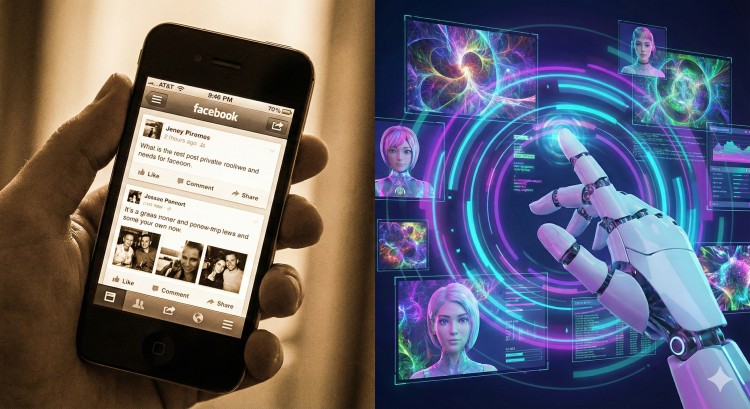
We are currently living through the single greatest inflection point in the history of human communication since the invention of the printing press. We are moving from the era of "Social Media"—platforms designed to connect humans to humans—to the era of "Synthetic Media"—platforms where humans interact with, consume, and are manipulated by Artificial Intelligence.
This isn't a gradual shift; it's a quantum leap. AI has escaped the backend server rooms and is now redesigning the very interface of our digital lives. The revolution is televised, tweeted, and TikTok'd, and it’s radically rewiring how we perceive reality itself.
Here is how the AI revolution is eating social media alive.
1. The Death of the "Social" Graph and the Rise of the Interest Engine
For a decade, social media was built on the "social graph"—who you knew determined what you saw. If you friended Aunt Brenda, you saw Aunt Brenda's political rants.
TikTok broke that model first, and AI perfected it. We have moved to the "interest graph." The algorithm no longer cares who your friends are; it cares about what makes your dopamine receptors fire.
Today's advanced AI recommendation engines (like those powering Reels, TikTok, and X's "For You") are analyzing thousands of data points per second: how long your thumb hovered over a video, the sentiment of the comments you read, the color palettes that stop your scroll.
The result? A feed that is hyper-personalized to an almost frightening degree. It knows you are considering a breakup before you tell your partner; it knows you're anxious about the economy before you check your bank account. AI has turned social media from a town square into a hall of mirrors designed specifically for you, reflecting back whatever keeps you addicted. The "social" aspect is secondary to the algorithmic hook.
2. The Content Explosion: Everyone is a Creator (and No One is Special)
Just two years ago, creating high-quality content required skill. You needed to know photography, videography, copywriting, or graphic design.
Then came Midjourney, ChatGPT, Runway Gen-2, and Sora.
Suddenly, the barrier to entry for creation dropped to zero. We are witnessing a Cambrian explosion of content. With a simple text prompt, anyone can generate photorealistic images, write 2,000-word thought leadership posts (like the ones flooding LinkedIn), or create surreal videos.

This democratization is both liberating and terrifying.
The Good: Creativity is unlocked for millions who couldn't draw a stick figure.
The Bad: We are drowning in noise. The volume of "good enough" mediocre content generated by AI is flooding every platform.
Social media is becoming a battleground not of human wit, but of prompt engineering. When everyone can create a masterpiece in seconds, what is the value of a masterpiece? We are shifting rapidly from capturing reality to generating reality.
3. Synthetic Beings: The Rise of the Virtual Influencer
Why pay a human influencer $50,000 for a brand deal when they might get embroiled in a scandal, age out of their demographic, or simply have a bad day?
Enter the Virtual Influencer.
Characters like Lil Miquela or Aitana Lopez are not real people. They are AI-generated personas with millions of followers, securing six-figure brand deals with companies like Prada and BMW. They are perfect, indefatigable, and entirely controllable.

This is the new frontier of parasocial relationships. Humans are now forming genuine emotional connections with entities that do not exist. As AI video and real-time voice interaction improve, these virtual beings will move from static Instagram posts to live streaming, interacting with fans in real-time.
When your favorite TikToker is an AI that remembers your birthday and chats with you for hours, will you care that they aren't human? The line between authentic connection and simulated intimacy is about to be completely erased.
4. The Dark Side: Turbocharged Echo Chambers and Deepfakes
If the old social media algorithms created filter bubbles, AI is building soundproof bunkers reinforced with steel.
Because generative AI can create content on demand, it can generate "evidence" to support any worldview instantly. A conspiracy theorist doesn't just have to find an obscure blog post to validate their belief; they can generate photorealistic images of events that never happened or deepfake audio of politicians admitting to crimes they didn't commit.
We saw the precursor to this with the AI-generated image of the Pope in a puffer jacket. It was funny. But the next iteration—a deepfake video released 24 hours before an election that is indistinguishable from reality—won't be.
AI on social media threatens to collapse our shared sense of reality. When you can't trust your eyes or ears, trust in institutions—and each other—erodes rapidly. We are entering a "post-truth" environment where the most engaging fabrication wins over the boring truth.
The Future: Agentic AI and the Metaverse
Where does this go next? We are moving toward Agentic AI.
Soon, you won't just doom-scroll yourself. You will have a personalized AI agent that curates your social existence. It will filter out the noise, summarize the drama for you, and perhaps even comment on posts on your behalf in your tone of voice.
We will see social media move into spatial computing (the Metaverse/Apple Vision Pro), where the NPCs (non-player characters) walking around aren't pre-programmed bots, but advanced LLMs capable of dynamic, endless conversation.
Conclusion: Retaining Our Humanity
The AI revolution of social media is inevitable. The toothpaste is out of the tube. We cannot stop the synthetic wave, but we must decide how to surf it.
As platforms become flooded with perfect, AI-generated beautiful people and hyper-optimized content, the most valuable currency will shift. We will crave raw, unfiltered humanity. Flaws, mistakes, genuine vulnerability, and unique, un-replicable human perspectives will become the ultimate luxury goods.
The challenge of the next decade isn't mastering AI tools. The challenge is remembering how to remain human while using them.




No comments yet. Be the first to share your thoughts!