The Office Is Obsolete: Why Clinging to the 9-to-5 Grind Is Killing Your Company (And How Remote Work Will Save It)
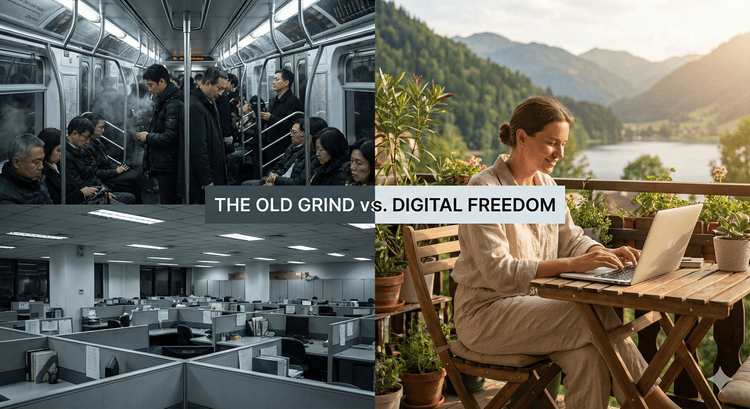
The Genie Is Never Going Back In The Bottle
Let’s be brutally honest for a moment. The traditional 9-to-5 model, tethered to a physical cubicle farm, was dying long before 2020. It was an artifact of the Industrial Revolution—a time when productivity was measured by how many hours you stood on an assembly line under a manager's watchful eye.
We are no longer in the industrial age. We are in the digital information age. Yet, so many companies are desperately trying to shove the square peg of modern knowledge work into the round hole of archaic office mandates.
If your company is currently debating "how many days we have to bring people back," you are asking the wrong question. You are fighting the future. And history shows that those who fight the future always lose.
Remote work isn’t a perk anymore. It isn't a "nice-to-have" for Friday afternoons. It is a fundamental shift in human capital strategy. It is the differentiator between companies that will thrive in the next decade and those that will slowly bleed talent until they are irrelevant.
Here is the undeniable business case for embracing the remote revolution, and why the most successful leaders are burning their return-to-office memos.

1. The Productivity Myth: Busted Once and For All
The biggest barrier to remote work has always been a lack of trust. "If I can't see them, how do I know they're working?"
This is lazy management. If the only way you know someone is being productive is by seeing their physical body in a chair, you have no idea how to measure output.
The data is in, and it’s overwhelming: Remote workers are frequently more productive than their in-office counterparts.
Why? Because the modern office is a distraction factory.
- The End of "Hey, Got a Minute?": In an office, deep work is constantly shattered by tap-on-the-shoulder interruptions, useless impromptu meetings, and loud open-plan environments. At home, employees can curate their environment for focus.
- Optimized Energy Cycles: Not everyone is productive at 9:00 AM. Remote work allows night owls to crush work at 10 PM and early birds to finish by noon. You get their best hours, not just their present hours.
When you shift from measuring hours sat to results delivered, productivity skyrockets.
2. The Talent Pool Just Went Global (And You’re Still Fishing in a Puddle)
The single hardest thing for any company to do is hire A-players. It is a brutal war for talent out there.
If you require your employees to live within a 45-minute commuting radius of your downtown headquarters, you have voluntarily restricted yourself to perhaps 1% of the available talent pool.
Why would you do that to your business?
When you embrace remote-first:
- Geography Dissolves: You can hire the best engineer in Estonia, the best marketer in Brazil, and the best designer in Japan.
- Diversity Flourishes: You naturally build more diverse teams because you aren't limited by the demographics of a single city’s zip codes.
- Retention Spikes: When an employee’s partner gets a job transfer to another state, you don't have to lose that employee. They just take their laptop with them.
Companies demanding a return to the office are currently experiencing a "brain drain" as their top performers—who know their worth—leave for flexible competitors. Don't be the training ground for your competition.

3. Stop Burning Cash on Empty Desks
Let's talk about the bottom line. Real estate is almost always the second biggest line item on a company's P&L after salaries.
Maintaining a shiny downtown headquarters is astronomically expensive. Rent, utilities, insurance, cleaning staff, artisanal coffee machines, snack bars—it costs thousands of dollars per employee per year just to house them.
A remote-first approach allows you to:
- Slash Overhead: Downsize to a much smaller "hub" for occasional meetings, or go fully distributed.
- Redirect Capital: Take that massive real estate savings and reinvest it in R&D, better employee salaries, or better technology tools.
Which is a better use of capital: paying rent to a landlord for an office that is 40% empty most of the time, or paying your top talent more money so they never leave you?
4. The Ultimate Wellness Benefit is Time
We are facing a burnout epidemic. Employees are exhausted, stressed, and re-evaluating their priorities.
The single most detrimental activity to employee happiness is commuting. It is unpaid labor that adds stress, costs money, and steals time away from family, hobbies, and rest.
Remote work gives employees their lives back. It gives them the flexibility to pick up their kids from school, to go to the gym at 2 PM when it’s empty, or just to sleep an extra hour instead of sitting in traffic.
When you treat your employees like adults and give them autonomy over their schedules, a remarkable thing happens: they become fiercely loyal. They are healthier, happier, and more engaged.
A happy workforce isn't just a nice HR metric; it’s a high-performing workforce.

The Final Verdict: Adapt or Die
The resistance to remote work usually boils down to fear. Fear of losing control. Fear of change. Fear that the way we did things for the last 50 years is suddenly wrong.
But the market doesn't care about your comfort zone.
The companies that will win the next decade are the ones that build systems based on trust, output, and flexibility. The companies that will lose are the ones that use attendance policies to manage grown adults.
The future of work is already here. It just happens to be in your employees' living rooms. Embrace it.




No comments yet. Be the first to share your thoughts!